Table of Contents
Chicago doesn’t give us much of a warm-weather window, so if you’re serious about upgrading your floors, this is the stretch to do it. A cracked, stained, or worn-out warehouse floor doesn’t fix itself, and waiting until October means fighting cooler slab temps and a longer cure time before your team can even walk on it again.
Summer just works better for commercial epoxy flooring in Chicago. The concrete’s warmer, the humidity is (usually) manageable, and contractors can move faster without heaters or extended dry times slowing everything down. It’s honestly one of those things where timing ends up mattering almost as much as the material itself.
Why the Season Actually Matters for Epoxy
People assume flooring is flooring, but epoxy is a chemical reaction before it’s a finished surface. It needs the right conditions to bond and harden properly, and Chicago’s summer months line up with what the product actually wants.
A few things play into that:
Concrete temperature matters more than most people expect. Epoxy tends to cure best somewhere between 60°F and 90°F, and slabs here naturally sit in that range once summer hits, no need for supplemental heating equipment.
Cure times shrink too. In colder weather, curing can take almost twice as long, especially once temps dip under 60°F. In summer, you’re looking at a shorter shutdown and a faster return to normal operations.
The material also flows better when it’s warm. Cold epoxy gets thick and stubborn, which leaves trowel marks or an uneven finish behind. Warm air keeps it workable long enough for your crew to get a clean, level result.
And humidity this one’s a bit more of a moving target. Once relative humidity climbs past roughly 60%, it can start interfering with adhesion and curing. Early-to-mid summer in Chicago tends to sit in a decent range, before the muggiest weeks of August roll in.
Summer vs. Winter, Side by Side
Factor | Summer Installation | Winter Installation |
Concrete temperature | Falls naturally within ideal range | Usually needs heaters or added time |
Cure time | Standard, predictable | Can run twice as long |
Humidity control | Easier to manage | Higher risk of condensation issues |
Business downtime | Shorter | Longer, harder to plan around |
Contractor availability | Books up quickly | More open scheduling |
Worth noting because summer works so well, it also books out fast. If you’re planning commercial epoxy flooring in Chicago this season, don’t wait until August to call around.

Upgrade to durable epoxy flooring installed by experienced Chicago professionals.
Who Benefits Most From a Summer Install
Not every business has the same flooring needs, but a handful of property types tend to see the biggest payoff:
Warehouses and distribution centers take a beating from constant forklift and pallet traffic. An epoxy floor coating for warehouse Chicago properties rely on holds up to abrasion, spills, and heavy point loads in a way bare or sealed concrete just can’t.
Manufacturing plants deal with oils, coolants, and chemical exposure daily, which is exactly why industrial epoxy flooring in Schaumburg IL facilities often need a heavier-duty system than a standard coating.
Retail spaces and showrooms get a real aesthetic boost a clean, glossy epoxy floor makes a strong first impression and shrugs off daily foot traffic.
Commercial kitchens do better with epoxy than tile, mostly because grout lines trap grease and bacteria in a way seamless epoxy never will.
Auto shops and service bays lean on it for chemical resistance and easy cleanup, especially with fluids and heavy equipment moving through all day. Contact your Chicago Commercial Contractor for precise review and quotes
What Actually Happens During a Proper Installation
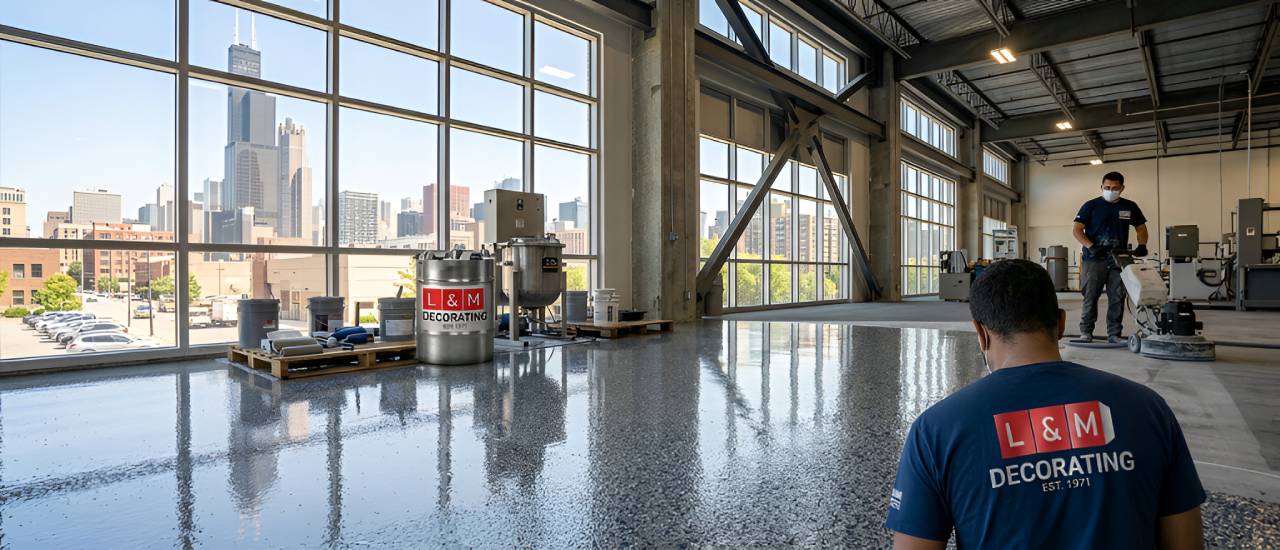
Most failures come from poorly prepared flooring. The epoxy won’t be the problem. A trusted contractor will grind or shotblast the concrete before applying the epoxy to be sure it bonds. If the epoxy is bonded to cracked concrete, the cracks will get fixed too. Trapped moisture is what causes most failures so a moisture test is critical before applying a primer coat. The base epoxy layer and top coat will be chosen based off the floor needs. There will be a UV resistant, slip resistant, chemically resistant top coat based on what the floor will experience. The curing will determine how long the space will be off limit. The floor also cannot be completely used during this time, as it is fully off limits.
Neglecting any of these steps will result in your business needing the epoxy in six months, just like most of our clients.
Why Work With an Experienced Commercial Construction Team?
Many flooring projects are part of larger renovations or facility improvements. Working with experienced commercial construction contractors in Chicago helps ensure flooring installation is coordinated with other upgrades, reducing delays and minimizing disruptions to daily business operations. Whether you’re renovating a warehouse, office, retail space, or manufacturing facility, having the right team in place makes scheduling and project management much more efficient.
What to Look For in a Contractor
Not every company treats epoxy the same way, and it shows in how long the floor holds up. If you’re trying to find the best commercial epoxy flooring in Chicago, a few questions tend to separate the good ones from the rest: Do they actually test slab moisture, or just eyeball it? Can they work around your schedule if a full shutdown isn’t an option? Do they have real photos or references from commercial jobs, not just home garages? And can they adjust coating thickness or resin type based on your traffic and chemical exposure?
At L&M Decorating, those are the exact conversations we have with clients before any work starts. We’ve installed commercial epoxy flooring across Chicago and the surrounding suburbs for years now, and we plan around this city’s climate instead of getting caught off guard by it as your trusted Chicago Residential Contractors
The performance of the floor after installation is impacted by temperature fluctuations, even after the epoxy has set. One industry resource recognizes that epoxy has the highest temperature sensitivity during the installation process. This is the exact reasoning behind the importance of scheduling everything correctly during the initial process.
FAQs
How long does commercial epoxy flooring last in Chicago?
Can epoxy flooring be installed in a working warehouse without shutting down operations?
Usually, yes. Contractors are able to separate parts of the warehouse and work in stages, which means that one area is treated while the other warehouse is running. It requires greater coordination and planning than complete shut down however it’s a standard request that we prepare for from the beginning.
Is epoxy flooring slippery when wet?
Glossy epoxy is prone to becoming slippery when wet. That’s why the majority of commercial projects add an anti-slip additive to the topcoat. This is especially important in garages, kitchens or any other areas that are close to oil or water. Consider discussing this the issue with your contractor prior to installation and not later.
How much does commercial epoxy flooring cost in Chicago?
It differs based on size, floor condition and the type of coating, but the majority of commercial projects fall between $3 to 12 dollars per square foot. Heavy industrial systems with chemical resistance tend to be at the upper end of the spectrum. A walkthrough is the only way to obtain an accurate number for your area.
L&M Decorating has spent decades helping Chicago-area businesses upgrade their spaces from office redesigns to industrial flooring that actually holds up under daily wear. We serve Chicago, Bolingbrook, Downers Grove, Evanston, Homewood, Lockport, and the surrounding communities. Summer slots are filling up fast, so reach out now to Chicago Epoxy Flooring Contractors to lock in your installation date. Call us at (312) 687-8707 or email us at Contact@lmdecorating.com